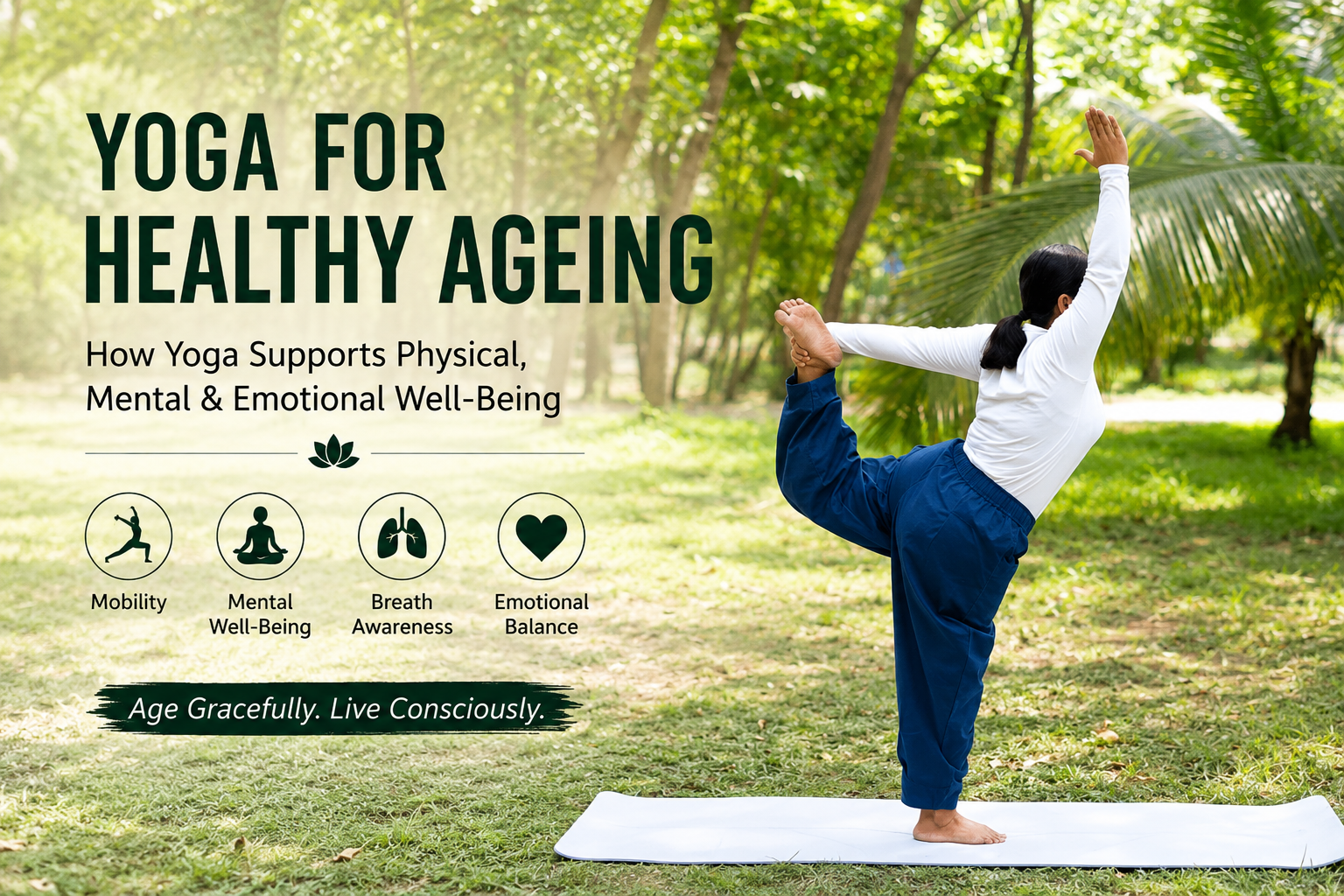
Yoga for Healthy Ageing: How Yoga Supports Physical, Mental & Emotional Well-Being
Ageing is a natural part of life, but growing older does not have to mean giving up strength, mobility, independence or inner vitality. Healthy ageing is increasingly understood not simply as living longer, but as maintaining the physical, mental, emotional and social well-being needed to live those years with greater quality and purpose.
Yoga offers a holistic approach to this process.
Unlike exercise systems focused primarily on physical performance, yoga brings together movement, breath awareness, meditation and mindfulness. This makes it a practice that can evolve with a person throughout life—from the early stages of adulthood to the 40s, 50s, 60s and beyond.
The relevance of this approach has received renewed global attention in 2026. The theme of the 12th International Day of Yoga was “Yoga for Healthy Ageing,” highlighting yoga's potential role in supporting physical vitality, mental resilience, emotional well-being and active ageing.
For people looking for a sustainable way to care for the body while cultivating greater awareness and inner balance, yoga can become much more than a physical practice. It can become a lifelong sadhana.
What Does Healthy Ageing Really Mean?
Healthy ageing is not about trying to stop the ageing process or maintaining the body exactly as it was decades earlier.
It is about supporting the abilities that allow a person to live independently, remain active and participate meaningfully in everyday life.
These can include:
- Maintaining mobility and flexibility
- Supporting strength and balance
- Staying physically active
- Managing everyday stress
- Maintaining emotional resilience
- Supporting mental well-being
- Remaining socially engaged
- Developing greater awareness of the body and mind
- Maintaining a sense of purpose and independence
The World Health Organization emphasizes physical activity across the lifespan and recommends that older adults include activities that support balance, particularly when mobility is limited.
This is where a consistent yoga practice can become valuable—not as a promise to reverse ageing, but as one adaptable way of supporting an active and aware lifestyle.
Why Is Yoga Relevant to Healthy Ageing?
Yoga combines several elements that are particularly relevant to ageing well: mindful movement, breathing, balance, flexibility, strength, relaxation and meditation.
The World Health Organization's 2026 discussion of yoga and healthy ageing notes that combining gentle movement, breathing and mindfulness can support abilities such as balance, flexibility, strength and mobility—qualities that are important for remaining active and independent as we age.
The key word here is adaptability.
A yoga practice does not need to remain the same throughout life. The intensity, duration, postures and approach can change according to a person's age, experience, mobility and individual needs.
That makes yoga suitable not only for people who have practiced for decades, but also for those who are discovering it later in life.
1. Yoga Can Support Mobility and Flexibility
One of the most noticeable changes that can accompany ageing is a gradual reduction in mobility.
Everyday movements that once felt effortless—getting up from the floor, reaching overhead, turning comfortably, walking for longer periods or maintaining a stable posture—may require more awareness and effort over time.
Yoga encourages people to move through controlled ranges of motion while paying attention to how the body feels.
Regular, appropriately adapted practice can help maintain flexibility and mobility, particularly when combined with an overall active lifestyle. The WHO identifies strength, flexibility, balance and mobility as important aspects of healthy ageing.
However, yoga should not become a competition.
For healthy ageing, the goal is not necessarily to achieve advanced poses. The goal is to maintain a functional, comfortable and aware relationship with the body.
2. Yoga and Balance as We Age
Balance becomes increasingly important with age.
Being able to stand, walk, change direction and move confidently depends on coordination, strength, body awareness and balance.
Yoga includes many practices that require awareness of alignment and stability. Even simple standing postures can encourage practitioners to become more conscious of how they distribute weight and control movement.
The WHO specifically recommends balance-focused physical activity for older adults with poor mobility to help reduce the risk associated with falls.
This does not mean that every older adult should attempt challenging balancing postures.
Instead, balance practices should be appropriate to the individual's ability and performed safely.
For someone beginning yoga later in life, a qualified teacher can help modify movements and provide support where necessary.
3. Yoga Can Help Maintain Strength and Functional Movement
Healthy ageing also involves maintaining the physical capacity required for everyday activities.
Strength is not only about lifting weights or performing difficult exercises. Functional strength helps with activities such as climbing stairs, carrying groceries, getting up from a chair and maintaining posture.
Certain yoga practices involve supporting and controlling the body's weight, while other forms of yoga can be combined with complementary strength-building activities.
The goal should be a balanced approach.
Yoga can form one part of an active lifestyle that includes appropriate movement, strength work, adequate recovery and healthy nutrition.
4. Breathing Becomes a Practice of Awareness
One of the distinctive aspects of yoga is that movement is not treated as separate from the breath.
Pranayama and breath awareness encourage practitioners to observe the relationship between breathing, attention and the state of the mind.
As we grow older, creating moments of calm and conscious breathing can be particularly valuable within an otherwise demanding lifestyle.
The WHO notes that yoga's combination of gentle movement, breathing and mindfulness can contribute to physical and mental well-being.
Rather than approaching breathing practices as a quick solution to every problem, a yogic approach encourages regularity and awareness.
A few quiet minutes of conscious breathing can become part of a broader daily practice.
5. Yoga, Meditation and Mental Well-Being
Healthy ageing is not only physical.
Mental and emotional well-being are equally important.
Life can bring significant transitions as people grow older: changes in work, family responsibilities, relationships, routines and social environments. These transitions can influence stress levels, emotional balance and one's sense of identity.
Meditation offers an opportunity to pause and observe the mind rather than constantly reacting to every thought or circumstance.
Yoga's broader practice of mindfulness and meditation may therefore complement physical movement by creating space for greater awareness and mental calm.
Current WHO guidance on yoga and healthy ageing highlights growing scientific interest in yoga's effects on stress, anxiety, mental well-being and aspects of brain health.
For Shaivam Shakti Yog, this distinction is particularly important.
Yoga is not simply about making the body more flexible.
It is also an opportunity to become more aware of how we think, respond, breathe and live.
6. Emotional Well-Being Matters Too
Ageing well also means creating space for emotional health.
A regular practice can offer a period of stillness in which a person can observe emotions without immediately becoming consumed by them.
Through movement, breath awareness, meditation and contemplation, yoga can encourage a more conscious relationship with one's inner experience.
This does not mean yoga should replace professional medical or mental-health care when such support is needed.
Rather, yoga can be viewed as one component of a broader lifestyle that supports well-being.
The 2026 International Day of Yoga theme specifically emphasized physical, mental and emotional dimensions of healthy ageing, reflecting this more holistic understanding.
7. Yoga Can Become a Lifelong Practice
One of the greatest strengths of yoga is that the practice can change as you change.
In your 20s, your practice may involve exploration, physical challenge and building discipline.
In your 40s, it may become more focused on maintaining mobility, managing stress and creating balance.
In your 50s and 60s, you may begin to value stability, breath awareness, meditation and mindful movement more deeply.
Later in life, a practice may become gentler while still offering meaningful opportunities for movement, awareness and inner connection.
The essence of yoga does not depend on performing increasingly difficult postures.
It lies in developing a deeper relationship with yourself.
Yoga for People in Their 40s, 50s, 60s and Beyond
There is no single yoga practice that is appropriate for every age group.
Two people of the same age can have very different levels of mobility, strength, experience and physical ability.
Therefore, age should not be the only factor used to determine how someone practices yoga.
Yoga in Your 40s
This can be a valuable stage for developing consistency.
A regular practice may focus on:
- Mobility
- Strength
- Flexibility
- Stress management
- Breath awareness
- Meditation
- Building sustainable daily habits
Yoga in Your 50s
The emphasis may gradually shift toward maintaining mobility, balance and functional strength while creating greater space for recovery and mindfulness.
Yoga in Your 60s and Beyond
A slower, more adaptable practice may be appropriate for many people.
Chair-supported practices, gentle movement, breathing exercises and meditation can make yoga accessible to people with different mobility levels.
The WHO emphasizes that yoga can be adapted for people of different ages and abilities, including those with mobility limitations.
The guiding principle should always be practice according to your ability, not according to someone else's performance.
How Beginners Can Start Yoga for Healthy Ageing
If you have never practiced yoga before, you do not need to begin with an hour-long routine or advanced postures.
Start simply.
Step 1: Begin with awareness
Spend a few minutes noticing your natural breathing and how your body feels.
Step 2: Introduce gentle movement
Choose simple movements that allow you to explore mobility without forcing your body.
Step 3: Add breath awareness
Coordinate comfortable movement with natural breathing rather than holding the breath or forcing it.
Step 4: Include stillness
End your practice with a few minutes of quiet sitting, relaxation or meditation.
Step 5: Build consistency
A shorter practice performed regularly can be more sustainable than an intense routine performed occasionally.
Step 6: Learn from a qualified teacher
Especially if you are new to yoga, have limited mobility or have specific health concerns, guidance from an appropriately qualified teacher can help you practice safely and make suitable modifications.
A Simple Daily Yogic Routine for Healthy Ageing
A beginner-friendly routine might look like this:
5 minutes — Breath awareness
Sit comfortably and observe the natural breath without forcing it.
10 minutes — Gentle movement
Use simple movements appropriate to your mobility and experience.
5 minutes — Balance and mindful standing
Practice stable, supported movements within your ability.
5–10 minutes — Meditation or quiet sitting
Allow the body to settle and observe the mind.
The exact duration is less important than consistency.
The practice should feel sustainable rather than exhausting.
And as with any physical activity, people should adapt exercise to their individual abilities and circumstances. WHO guidance emphasizes starting according to one's capacity and maintaining appropriate physical activity as part of healthy ageing.
Common Mistakes to Avoid When Starting Yoga Later in Life
Healthy ageing through yoga does not mean pushing the body harder.
Some common mistakes include:
Trying to copy younger or more experienced practitioners
Your practice should be based on your body and current ability.
Forcing flexibility
Flexibility should develop gradually. Pain is not a measure of progress.
Ignoring balance and stability
Mobility is valuable, but stability and balance are equally important.
Treating yoga as only physical exercise
Breathing, awareness and meditation are essential aspects of a complete yogic practice.
Practicing inconsistently
A sustainable routine is often more valuable than occasional intense sessions.
Ignoring professional guidance when necessary
People with medical conditions, significant mobility limitations or other concerns should seek appropriate professional advice before beginning or modifying physical activity.
Yoga for Healthy Ageing Is More Than Physical Practice
The deeper value of yoga lies in its ability to bring different dimensions of well-being together.
The body needs movement.
The breath needs awareness.
The mind needs space.
The emotions need attention.
And life needs conscious participation.
This is where yoga begins to move beyond the idea of exercise.
Healthy ageing is not simply about preserving the body.
It is also about remaining connected—to yourself, to your surroundings and to the life you are living.
A consistent yogic practice can become a space where movement, breath, meditation and self-awareness meet.
From Yoga Practice to Sadhana
A yoga session may last an hour.
Sadhana is the deeper commitment to making awareness a part of everyday life.
When yoga becomes regular rather than occasional, it can gradually become a discipline—a way of returning to yourself each day.
This is the essence of a sadhana practice.
At Shaivam Shakti Yog, the approach to yoga extends beyond physical postures toward conscious living, self-awareness, inner balance and transformation.
Healthy ageing, from this perspective, is not about resisting change.
It is about meeting change with awareness.
Frequently Asked Questions About Yoga for Healthy Ageing
Yoga can be one component of a healthy ageing lifestyle. Its combination of movement, breathing and mindfulness can support areas such as flexibility, balance, mobility, strength and mental well-being.
Yes. People can begin yoga at different stages of life. Practices can be modified according to mobility, experience and individual ability. Beginners should start gradually and consider learning from a qualified teacher.
Yoga can be adapted for older adults, including through gentle and chair-supported practices where appropriate. The practice should be matched to the individual's abilities and circumstances.
Regular, appropriately adapted movement can help maintain mobility and flexibility. The goal should be gradual, comfortable progress rather than forcing the body into difficult positions.
Balance is an important part of healthy ageing, and yoga includes practices that develop body awareness, stability and controlled movement. Older adults with mobility or balance concerns should use appropriate modifications and guidance.
Meditation is an important component of the broader yogic tradition. A complete practice can include physical movement, breath awareness, concentration, meditation and self-observation.
There is no single “best” age. Yoga can be adapted for different stages of life. The most important consideration is choosing a practice appropriate to your current abilities and maintaining it consistently.
There is no universal number of yoga sessions suitable for everyone. A sustainable routine that fits the individual's abilities and broader physical activity needs is preferable to an unnecessarily intense schedule.
Begin Your Journey Towards Conscious Ageing
Healthy ageing is not a destination.
It is a way of living.
With mindful movement, conscious breathing, meditation and consistent practice, yoga can become a lifelong companion—supporting not only the body, but also greater awareness and inner balance.
And perhaps the deeper question is not:
“How can I stop ageing?”
but:
“How can I live each stage of life more consciously?”
That is where yoga becomes more than exercise.
It becomes a practice of living.
Ready to begin your own yogic journey?
Explore Sadhana Prarambh, a guided 21-day journey designed to help establish a consistent personal sadhana and create a deeper foundation for conscious yogic living.er trust as well as long-term SEO quality.