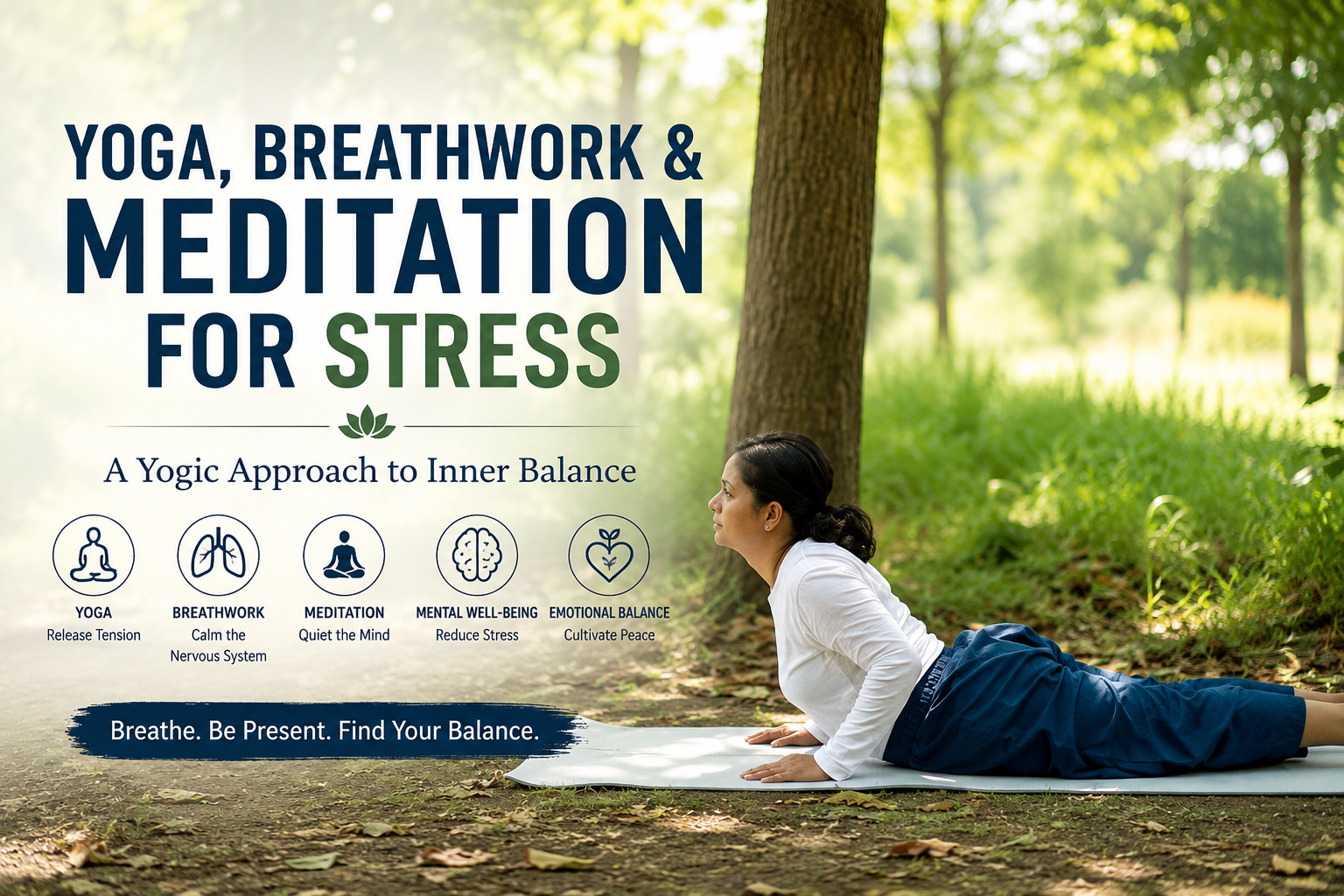
Yoga, Breathwork & Meditation for Stress: A Yogic Approach to Inner Balance
Modern life rarely gives the mind much opportunity to slow down.
Between work, responsibilities, constant notifications, financial pressures, family commitments and an endless stream of information, it can be difficult to find moments of genuine stillness. Stress has become such a familiar part of everyday life that many people simply learn to live with it.
But stress is not only a mental experience.
It can affect the body, breathing patterns, concentration, sleep, emotions and the way we respond to everyday situations. The World Health Organization describes stress as a natural response to challenging situations, while also noting that excessive stress can affect both mental and physical well-being.
This is where yoga offers a perspective that goes beyond exercise.
A yogic approach brings together movement, breath awareness, pranayama, meditation and conscious living. Rather than treating the body and mind as completely separate, yoga encourages us to observe how they influence one another.
Research is also increasingly examining yoga, meditation and other mind-body practices for stress management. The National Center for Complementary and Integrative Health (NCCIH) notes that research has found potential benefits of yoga and mindfulness practices for aspects of stress and mental well-being, although results vary across practices and individuals.
So, can yoga, breathwork and meditation help you relate to stress differently?
They can become valuable tools for developing awareness, steadiness and inner balance.
The goal is not to promise a life without stress.
It is to develop a more conscious way of meeting it.
What Is Stress and How Does It Affect the Body and Mind?
Stress is the body's natural response to challenges or perceived threats.
A certain amount of stress can be useful. It can help us respond to deadlines, solve problems and deal with demanding situations.
The difficulty arises when stress becomes persistent or overwhelming.
According to the WHO, excessive stress can contribute to difficulties such as irritability, trouble concentrating, headaches, body pains, digestive problems and sleep difficulties.
Stress can therefore become a cycle:
A demanding situation → mental tension → physical tension → altered breathing → difficulty relaxing → more mental tension.
Yoga approaches this cycle by bringing attention to several points at once.
You may notice the tension in your body.
You may become aware of your breathing.
You may observe the movement of your thoughts.
And gradually, you may create more space between what happens around you and how you respond.
This is one of the deeper possibilities of yoga.
How Is a Yogic Approach to Stress Different?
Many approaches to stress focus primarily on removing the stressful situation.
But that is not always possible.
You cannot always remove a demanding job, change every family responsibility or control everything happening around you.
A yogic approach begins with something more accessible:
Awareness of your own experience.
Instead of immediately reacting to tension, you learn to observe:
- What is happening in the body?
- What is happening with the breath?
- What thoughts are repeating?
- How quickly am I reacting?
- Can I create a moment of pause?
- What happens when I bring my attention back to the present?
This does not mean ignoring difficult circumstances.
It means becoming more conscious of how you meet them.
Yoga is traditionally much broader than physical postures. Modern research descriptions commonly include combinations of asanas, pranayama and meditation, while classical yoga encompasses a broader philosophical and contemplative framework.
That broader perspective makes yoga particularly relevant to the idea of inner balance.
Yoga for Stress Relief: Bringing Awareness Into the Body
When people experience stress, they may notice physical tension without realizing that the body is responding to the mind.
The shoulders become tight.
The jaw clenches.
The breath becomes shallow.
The body feels restless.
A mindful yoga practice creates an opportunity to notice these sensations rather than moving through them automatically.
Gentle Yoga and Physical Tension
You do not need an intense yoga session to practice awareness.
Gentle movements can be enough to bring attention back to the body.
A slower practice may involve:
- Comfortable spinal movements
- Gentle stretches
- Mindful standing postures
- Slow transitions
- Relaxation
- Conscious breathing
The intention is not to force the body into flexibility.
It is to develop a more attentive relationship with physical sensation.
Research summarized by NCCIH suggests that yoga may help with measures related to stress, while also noting that evidence differs across studies and forms of yoga.
For this reason, it is better to think of yoga as a potentially supportive practice for stress management, rather than a guaranteed treatment for stress-related conditions.
The Connection Between Breath and Stress
Breathing is one of the most accessible aspects of a yogic practice.
You are breathing all day, yet you may rarely notice how your breathing changes according to your state of mind.
Think about what happens when you are:
- Rushing to finish something
- Nervous before an important conversation
- Concentrating intensely
- Feeling angry
- Sitting quietly in nature
Your breathing may feel different in each situation.
Yoga brings this ordinarily automatic process into conscious awareness.
That is the foundation of breath awareness.
What Is Pranayama?
Pranayama is the yogic discipline of working with the breath.
Different traditions teach different pranayama techniques, and they can vary considerably in purpose, method and intensity.
For someone beginning a stress-management practice, however, the first step does not necessarily need to be a complex breathing technique.
It can simply be:
Notice the breath.
Observe its natural rhythm.
Notice whether it feels smooth or strained.
Allow your attention to rest with the breath.
This simple act can create a moment of interruption in an otherwise busy day.
For more advanced pranayama techniques, learning from a qualified teacher is advisable, particularly because not every breathing technique is appropriate for every person.
Breathing Exercises for Stress: Start With Awareness
If you are new to breathwork, avoid approaching breathing exercises as a competition.
You do not need to take the deepest breath possible.
You do not need to hold your breath for long periods.
And you should not force your breathing.
A simple practice can begin with comfortable breathing:
- Sit in a stable, comfortable position.
- Relax the shoulders and face.
- Notice the natural breath.
- Observe the inhalation without changing it.
- Observe the exhalation without forcing it.
- Continue for several comfortable cycles.
- If you become uncomfortable, return to natural breathing.
The purpose is awareness, not performance.
If you are learning a particular pranayama technique, follow the instructions of a suitably qualified teacher.
Meditation for Stress: Creating Space Around Thoughts
Stress does not exist only in the body.
The mind can also become caught in repetitive thoughts.
You may replay a conversation.
Worry about tomorrow.
Think about unfinished work.
Imagine future problems.
Or repeatedly revisit something that has already happened.
Meditation offers an opportunity to observe this mental activity without immediately following every thought.
Does Meditation Mean Stopping Thoughts?
Not necessarily.
One of the most common misconceptions about meditation is that you have to completely empty your mind.
For many beginners, this expectation creates even more frustration.
Instead, meditation can begin with simply noticing.
A thought appears.
You notice it.
You return your attention to the breath, body or chosen point of focus.
Another thought appears.
Again, you notice.
Again, you return.
The practice is not about never getting distracted.
It is about learning to return.
NCCIH notes that mindfulness meditation cultivates focused attention and greater awareness of the present, with research suggesting potential benefits for symptoms associated with stress.
Yoga, Breathwork and Meditation: Why Combine Them?
Each practice can offer a different entry point into awareness.
Yoga brings attention to the body.
You notice movement, posture, sensation and physical tension.
Breathwork brings attention to breathing.
You begin to observe the relationship between breath and your experience.
Meditation brings attention to the mind.
You observe thoughts, emotions, sensations and attention itself.
Together, they can create a more integrated practice.
Body → Breath → Mind → Awareness
This is particularly aligned with a yogic understanding of holistic well-being.
Rather than trying to “fix” one isolated part of yourself, you create opportunities to observe the whole experience.
How Yoga Can Support Emotional Balance
Stress can influence emotional responses.
When overwhelmed, a person may become more irritable, impatient or reactive.
A regular contemplative practice can create moments in which emotions can be observed rather than immediately acted upon.
This does not mean suppressing emotions.
It means learning to recognize them.
For example:
“I am feeling irritated.”
is different from immediately becoming:
“I am an irritated person.”
The first statement creates observation.
The second can create identification.
Yoga and meditation can encourage this subtle shift toward awareness.
NCCIH's review of yoga research notes potential benefits for general mental and emotional well-being, while emphasizing that the evidence and effects vary across populations and practices.
The Importance of Consistency
One yoga session may feel refreshing.
One meditation session may create a moment of calm.
But the deeper value of a practice often develops through consistency.
This is why a yogic approach to stress is not necessarily about finding the perfect technique.
It is about creating a sustainable relationship with practice.
Five minutes today.
Ten minutes tomorrow.
A longer practice when your schedule allows.
And, importantly, returning when life interrupts the routine.
This idea connects directly with sadhana.
Sadhana can be understood as a committed practice undertaken with intention and regularity.
When yoga, breath awareness or meditation becomes part of a consistent daily practice, the objective gradually shifts from:
“I need to relax because I'm stressed.”
toward:
“I am developing a more conscious way of living.”
That is a much deeper transformation.
A Simple 15–20 Minute Daily Practice for Inner Balance
If you want to create a simple routine, you can begin with a structure such as this.
1. Arrive — 2 minutes
Sit quietly.
Put aside your phone and other distractions.
Notice how you feel without trying to change anything.
2. Gentle movement — 5 minutes
Practice comfortable, mindful movements appropriate to your experience.
Move slowly.
Pay attention to sensation rather than trying to achieve a particular shape.
3. Breath awareness — 3–5 minutes
Allow the breath to become the focus of your attention.
Avoid forcing or over-controlling it.
4. Meditation — 5 minutes
Sit comfortably.
Observe the breath or another chosen point of attention.
When thoughts arise, notice them and gently return.
5. Closing awareness — 1–2 minutes
Before continuing your day, pause.
Notice:
How do I feel now?
What has changed?
Can I carry some of this awareness into my next activity?
This is a general wellness framework, not a prescribed treatment or individualized medical program.
Yoga vs Exercise for Stress Management
Yoga and conventional exercise do not have to compete with each other.
Both can have a valuable place in a healthy lifestyle.
Exercise may focus on:
- Cardiovascular fitness
- Strength
- Endurance
- Mobility
- Physical conditioning
Yoga can incorporate physical movement while also emphasizing:
- Breath awareness
- Attention
- Mindfulness
- Meditation
- Relaxation
- Self-observation
In practice, the two can complement one another.
You do not have to choose between being physically active and developing inner awareness.
A balanced lifestyle can include both.
Can Yoga Help With Stress?
Research suggests that yoga may help with aspects of stress management.
NCCIH cites a 2020 review of 12 studies involving healthy adults that found beneficial effects of yoga on measures of perceived stress. However, research findings vary, and yoga should not be presented as a guaranteed solution for stress or as a substitute for professional treatment.
The WHO also notes that yoga can support stress relief, emotional balance and overall mental and physical well-being.
The most useful way to think about yoga may therefore be as one supportive practice within a broader approach to well-being.
What About Yoga for Anxiety?
Stress and anxiety are related but are not identical.
Yoga may help some people manage everyday anxiety symptoms, but evidence is not strong enough to claim that yoga alone treats anxiety disorders.
NCCIH notes that some studies have found yoga helpful for anxiety symptoms, while evidence for diagnosed anxiety disorders remains inconclusive. It also emphasizes that established treatments such as cognitive behavioral therapy remain important when clinically appropriate.
This distinction matters.
Yoga can be part of a supportive self-care routine.
It should not be positioned as a replacement for professional mental-health care.
If stress or anxiety is persistent, severe or interfering significantly with daily life, speaking with an appropriate healthcare professional is important.
How Conscious Living Can Support Long-Term Balance
Stress management does not have to happen only when stress becomes overwhelming.
A more conscious lifestyle can involve noticing the choices that influence your everyday state.
For example:
- How often do you pause during the day?
- How much time do you spend constantly consuming information?
- Do you notice when you are becoming physically tense?
- Are you eating and sleeping regularly?
- Do you create time for movement?
- Do you make space for quiet?
- Are you constantly reacting, or do you sometimes pause before responding?
These questions move the conversation beyond:
“How do I get rid of stress?”
toward:
“How do I live more consciously?”
That shift is central to the deeper philosophy of yoga.
From Stress Relief to Inner Balance
It is easy to approach yoga as a tool.
Feeling stressed?
Do yoga.
Can't sleep?
Meditate.
Feeling tense?
Do breathing exercises.
These practices can certainly be useful.
But the yogic tradition offers a broader possibility.
The practice is not only about what you do when something goes wrong.
It is about developing awareness before, during and after challenging experiences.
Over time, you may become more familiar with:
- Your reactions
- Your habits
- Your breathing
- Your physical tension
- Your emotional patterns
- Your attention
- Your relationship with yourself
This is where yoga becomes a practice of self-awareness rather than simply stress relief.
Common Mistakes When Using Yoga for Stress
Trying to Do Too Much
An hour-long routine is not necessary for everyone.
Start with something sustainable.
Forcing the Body
Yoga is not about competing with another person's flexibility.
Move within an appropriate range and respect discomfort and pain.
Treating Breathwork as a Performance
More intense does not necessarily mean more beneficial.
Especially with pranayama, learn techniques properly and practice within appropriate limits.
Expecting Immediate Results
A single session may feel pleasant, but meaningful habits develop over time.
Using Yoga as a Replacement for Professional Care
Yoga can be supportive, but it should not replace appropriate medical or mental-health treatment.
Practicing Without Guidance When You Need It
Beginners can benefit from learning from a qualified teacher, especially when exploring unfamiliar physical or breathing practices.
NCCIH notes that yoga is generally considered safe for healthy people when practiced appropriately, but injuries can occur, particularly when practices are performed incorrectly.
How to Build a Sustainable Yoga and Meditation Routine
A sustainable routine is usually simpler than people expect.
Choose consistency over intensity.
A short daily practice can be easier to maintain than occasional long sessions.
Create a dedicated space.
Even a small, quiet corner can become associated with practice.
Reduce distractions.
Put your phone away during your practice.
Practice at a predictable time.
A regular schedule can make it easier to build a habit.
Allow your practice to evolve.
Some days may call for gentle movement.
Other days may allow more meditation.
The practice can adapt without losing its purpose.
Return when you stop.
Missing several days does not mean you need to abandon the practice.
Begin again.
Yoga, Meditation and Stress: The Deeper Perspective
Stress is a part of human life.
The goal of a yogic practice is not necessarily to create a life in which nothing difficult happens.
That is unrealistic.
Instead, yoga invites us to develop a deeper relationship with our experience.
We learn to notice the body.
We learn to observe the breath.
We learn to watch the mind.
We create moments of stillness.
And slowly, we may become less automatic in the way we respond.
This is why yoga can be understood as more than physical fitness.
It can become a path toward awareness, balance and conscious living.
Begin With a Simple Practice
You do not need to wait for the perfect morning.
You do not need a large space.
You do not need advanced flexibility.
And you do not need to know everything about yoga before you begin.
Start with a few minutes.
Sit.
Breathe.
Move consciously.
Observe.
Be still.
Then return tomorrow.
Over time, these small moments can become a meaningful daily practice.
At Shaivam Shakti Yog, this approach extends beyond physical yoga toward conscious yogic living, self-awareness and inner transformation.
If you want to develop a more consistent practice, Sadhana Prarambh offers a structured 21-day beginning designed around establishing a regular sadhana.
Because the deeper purpose of practice is not simply to feel better for an hour.
It is to learn how to meet life with greater awareness.
Frequently Asked Questions About Yoga, Breathwork & Meditation for Stress
Research suggests that yoga may help with aspects of stress management, including perceived stress and general mental and emotional well-being. Results vary between studies, so yoga is best viewed as one supportive practice rather than a guaranteed treatment.
Some research suggests that mindfulness meditation may help reduce symptoms associated with stress and improve aspects of well-being. However, individual experiences vary, and meditation should not be treated as a substitute for appropriate professional care.
There is no single best style for everyone. Gentle, mindful practices that allow you to move comfortably, pay attention to the breath and slow down may be appropriate for people looking to develop a calmer practice.
Conscious breathing can become a useful part of a relaxation and mindfulness routine. Beginners should start with comfortable natural breathing and learn more advanced pranayama techniques from a qualified teacher.
There is no universal duration. A short, consistent practice may be easier to maintain than occasional long sessions. Even 10–20 minutes can provide a structured opportunity for movement, breath awareness and meditation.
Yoga and exercise serve different purposes and can complement one another. Yoga combines physical movement with breath awareness and meditation, while other forms of exercise may provide greater emphasis on cardiovascular fitness, strength or endurance.
Some studies suggest yoga may help with anxiety symptoms, but evidence regarding diagnosed anxiety disorders remains inconclusive. Yoga should not replace evidence-based professional treatment when that is needed.
Pranayama refers to yogic breath practices. Breath awareness can help bring attention to the present moment, while specific pranayama techniques may require appropriate instruction. Beginners should avoid forcing the breath or experimenting with advanced techniques without guidance.
Either can work. Some people find that movement helps them settle before meditation, while others prefer beginning with quiet sitting. Choose the sequence that allows you to practice comfortably and consistently.
Yes. Yoga, breath awareness and meditation can be incorporated into a daily sadhana. The most important factor is creating a sustainable routine rather than attempting an unnecessarily demanding schedule.
Final Thoughts: From Stress Management to Conscious Living
Yoga does not promise a life without pressure, uncertainty or difficult experiences.
Instead, it offers an opportunity to become more aware of how you experience them.
Through mindful movement, conscious breathing and meditation, you can create moments of pause within an otherwise demanding day.
And with consistency, those moments can become more than moments.
They can become a practice.
A practice of returning to the breath.
A practice of observing the mind.
A practice of listening to the body.
A practice of responding rather than simply reacting.
Ultimately, the deeper question may not be:
“How can I eliminate all stress from my life?”
but:
“How can I meet life with greater awareness and inner balance?”
That is where the practice of yoga begins to extend beyond the mat.
And that is where yoga can become a way of living. conscious living, rather than competing for the extremely broad keyword “yoga.”